 Originally published December 10, 1999, in Comics Buyer’s Guide #1360
Continuing our sojourn to the Fantabaires convention in Argentina…
November 5 (continued): The hotel is a perfectly nice one in downtown Buenos Aires (the city of Buenos Aires, we’re told, as distinguished from the general area of Buenos Aires. Kind of like New York, New York.) We settle in, get acclimated to the area a bit, and are then brought over to the convention site.
The place is huge and, since it’s fairly early on a Friday, relatively empty. The dealer’s room has aisles so wide that you could field a hockey team in it. We recognize it, however, as the same type of dealer’s room as we saw down in Mexico. That is to say, once the convention gets going, the place is going to be absolutely packed and maneuvering will suddenly be a problem.
I’m set for a question and answer session that evening. It’s slated for two hours, but in reality it’s only a one hour panel, because everything has to be said twice. Questions are posed in Spanish, translated into English, I respond, and then it’s back into Spanish.
It’s called “Spotlight on Peter David.” The name is literal: It’s a fairly dark room and there is a glaring spotlight trained on me. The reception by the audience is monumental. I’ve never gotten an ovation like that. The applause goes on for nearly a minute. If that doesn’t sound like a long time, try banging your hands together and see what it really feels like. The welcome seems to come in waves, literally washing over me. I find myself wishing that I could bottle the audience and take them with me wherever I go.
There is, as usual, the little quirks of translation. Someone will pose a question in Spanish and you hear the audience laughing or reacting, and nothing gives you more of a sense of dread than knowing that something’s coming your way and every dámņëd person in the room except you is aware of precisely what it’s going to be. On the other hand, you also get a feel of who can speak English and who can’t, because the English-speaking folks laugh at jokes I make before the rest of the audience does.
Also, several people are brought up with whom I’ve worked: Ariel Olivetti, who painted The Last Avengers Story (which as long-time readers know saw publication thanks to Comic Buyers Guide) and Ricard Villagren who was my inker during my run on DC’s Star Trek. It’s like a Spanish-language edition of This is Your Life.
The thing that takes the most getting used to is the meal hours. Folks don’t eat dinner until at least 10:30, even later. The convention takes Kathleen, Mark Waid and Devin Grayson, and me, out to an Italian restaurant. We don’t actually eat until close to midnight. It’s a good way to completely throw off your digestive system.
November 6—Kathleen has awoken apparently covered with mosquito bites. Oddly, I picked up none at all. One would think that if there are mosquitoes in the air, they wouldn’t discriminate.
We are, I am told, going to be going to the cemetery today. I am able, with staggeringly little effort, to restrain my enthusiasm. I can think of nothing interesting about such an outing, aside from going around and looking at headstones and trying to find intriguing epitaphs. (I still debate about my own. I keep thinking of “To Be Continued,” or perhaps, “Suddenly…” or “What the–?!” or “Meanwhile…” or, if we move away from comics, “What are you lookin’ at?” or “Shhhhh” or “Out to Lunch.”)
I could not be more wrong, as it turns out, because the Cemetery of Recoleta is the Beverly Hills of cemeteries. Built in 1822, it’s like a small, fenced-in city, with paved roads and everything, composed (or decomposed… nyuk nyuk) entirely of mausoleums. And a number of them are beyond belief. Some of them are like cathedrals. There are dead people residing in places bigger than my first apartment. There is incredible statuary all over the place, ranging from soldiers to sobbing angels. Probably the most controversial resident is Eva Peron before she was Patti Lupone or Madonna. The families of the Recoleta residents complained because they felt that (their characterization, not mine) a whørë who slept her way to power was not fit company. But Peron insisted and as a result, Evita’s body was laid in Recoleta (which was apparently the only place in Argentina it hadn’t been previously.)
At the convention, Devin and I wind up on a panel with about ten other people. It’s held in a room where we are absolutely melting, it’s so hot. Most of the people in the room are using the program books or comics to fan themselves. Being an overweight Jewish man, I don’t just sweat; I shvitz. If I had several oversized towels, shower slippers, and a copy of the Jerusalem Times, I’d be all set. There is much heated discussion, but considering that my eyebrows are sliding into my nostrils, there’s not much about the room that isn’t heated. At one point there is intense debate about whether comics and magazines will ever be replaced by electronics. And I say to the crowd, “Do you want to know why there will always be printed comics and magazines?” They do. I grab a magazine and, while fanning myself furiously, say, “Because you can’t do this with a computer, that’s why.”
We go to a barbecue organized by the nice convention folk. Mark, Devin, Kathleen and I are all exhausted and would rather just grab a relatively early dinner and crash out. But to refuse the invitation would be rude, and so we go.
The grill itself is massive. Beyond massive (although we’re later told that actually, by Argentine standards, the grill is quite small. Remarkable. I have grill envy.) I think what they did was cut off the cow’s head, legs and tail, broke the rest of the carcass in half and tossed it on the grill. This is Argentina, after all, the land of meat. At dinner the host is anxious to get Devin to try a piece of the cow. Devin tries to explain that she’s a vegetarian. “Just a small piece, then!” the anxious cook tells her with pride, not wanting her to miss out on the great food (and it is delicious, I’ll give ’em that.) Devin looks desperately uncomfortable, stuck. I distract the gentleman and palm the meat off Devin’s plate. She looks grateful. More for me. Me, I’m steering away (you should pardon the expression) from meat and staying with the barbecued chicken. But after cleaning off a plate of it, I learn it’s not chicken; it’s cow entrails or something. If I’d known it before hand, I’d never have tried it. Old provincial me. I know it’s such a cliché, but… dámņ, it really did taste like chicken.
It’s one thirty in the morning. We’re exhausted. Devin’s knee is throbbing. And Kathleen’s “mosquito bites” are clearly worse than that; it’s hives, all over her back. She’s had an allergic reaction to something from the night before. She’s itching like mad. We convey to our hosts that we’d like to go back to the hotel. They’re astounded; the party’s just getting started. Again, we don’t want to be rude. And I said, “Look, we’d love to say, but Devin’s knee is killing her and Kathleen isn’t feeling well… she’s got hives! Honey, show them your hives!” And without further ado, I pull down the back of Kathleen’s shirt. There are hives all over the back of her shoulders. Our hosts are immediately one hundred percent solicitous and within minutes we’re being driven back to the hotel. We learn later that the party went to seven in the morning. Considering how tired we were, we are grateful to Kathleen’s hives for giving us a polite way of leaving at an hour that we can handle. Kathleen doesn’t seem especially grateful for them, though, although some antihistamine and rash powder brings them under control.
November 7: We are being driven in two cabs to an antique fair, and as we round a large plaza, we see the east side of the Casa Rosada, the “Pink House” best known to Americans as the place with the balcony where Evita told Argentina not to cry for her. It’s one of the best known sites. “We’ve got to take a picture of that! Can we pull around?” we ask the driver as we sit at a light. There’s honking to our left. It’s Mark and Devin, and they’re pointing at the same thing, and waving their camera. So we’re obviously on the same wavelength.
The thing is, the Casa Rosada is undergoing renovation. What’s usually done in such instances is that a huge white sheet or some other bland protection is erected outside, obscuring the view. But since the Casa Rosada is such a popular place and the Argentinians didn’t want to disappoint visitors, they came up with a hilariously inventive compromise. Hanging directly in front of the Casa Rosada is a gigantic picture of… the Casa Rosada. It’s like the old Steven Wright joke about getting a map of the United Scales that’s actual size. This is an actual size portrait of the Casa Rosada.
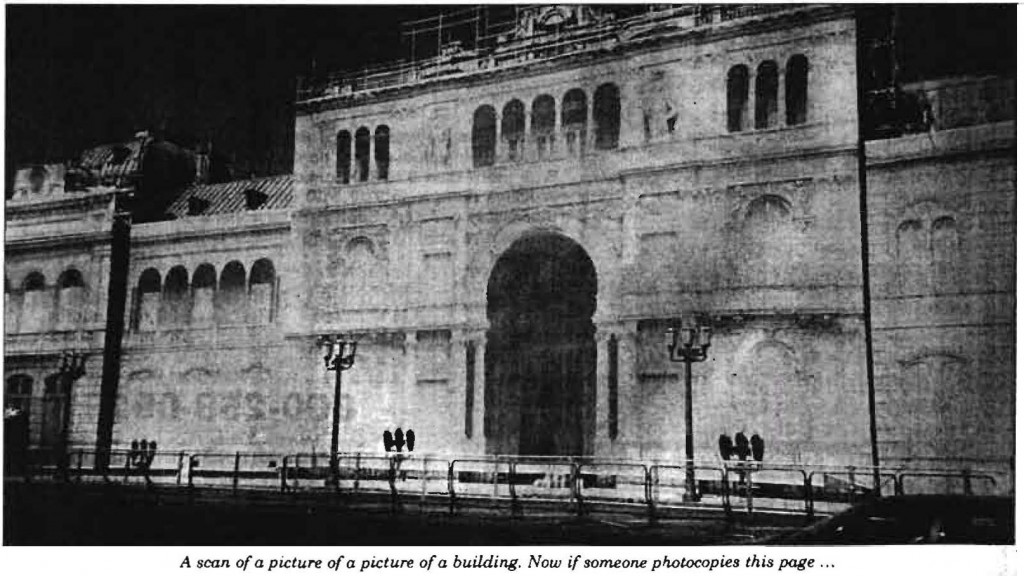
I start photographing away, because there is something hilariously circular to me to take pictures of a picture of a building. “What building is this a picture of?” “It’s not. It’s a picture of a building.” Only in Argentina. Well, and maybe in Toontown. I think they missed a bet: They should have dropped in a photo of Eva Peron on the balcony just to make the thing complete.
Just think: If they’d been content to put a picture of Eva Peron in Recoleta, they could have saved a lot of hassle.
(Peter David, writer of stuff, can be written to at Second Age, Inc., PO Box 239, Bayport, NY 11705.



 •
• 
We used the same silly trick during the renovation of the US Supreme Court. (Which may still have it’s facade under construction – I last saw it, covered, in Oct 2012.)
I guess that’s why the magazine and newspaper industries are suffering even more today – you can fan yourself with a tablet or an e-reader…
Yeah, but if you’ve already got sweaty hands, you may not want to wave an expensive tablet around too vigorously…
First thought: You should write a book about all your convention experiences. PAD’s Adventures In Time and Really Small Spaces, or something.
Second thought: The magazine you fanned yourself with would probably fetch a nice price on eBay.