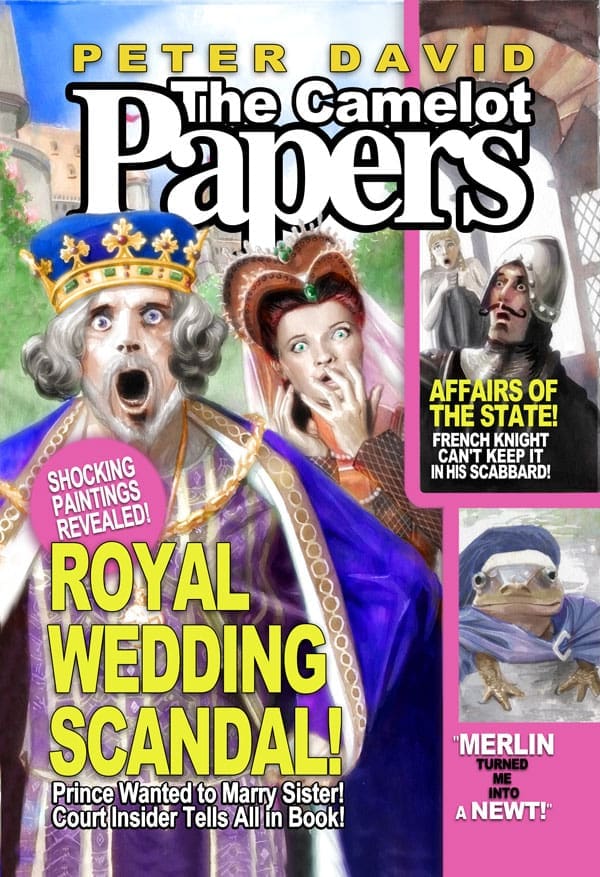
I’ve just been informed that we’ve sold German rights to the new edition of KNIGHT LIFE. Hopefully they’ll also be interested in picking up ONE KNIGHT ONLY.
Oddly, SIR APROPOS OF NOTHING (which has editions in several countries)–well reviewed, strong selling–still has no interest from publishers in England, where I’d’ve thought it’d be a natural. Go figure.
PAD


 •
• 
Congratulations! This seems like a good place to ask, since I’m curious: How do foreign-language editions handle the wordplay in the “Apropos” books? Finding native equivalents for names like Lord Belliquose is one thing, but the phrase “Woad to Wuin” plays on a well-known phrase (which is also descriptive of the book’s theme, roughly) and a noun which also evokes the book’s themes (woad–>warriors, and don’t think I didn’t notice the potential wordplay there). Not to mention combined wordplay and cultural references like the Thirty-Nine Steppes. Does anyone out there have any examples of how this has been treated?
Given that England is the land of Pratchett, I am quite surprised. Or maybe they ar afraid that after 27 Discworld books, there’s no market for fantasy there anymore.
Just out of curiosity, has anyone seen the new version of Knight Life on bookshelves anywhere in Canada? I’ve been looking for it since it was (re)published and, while I can get it easily from online stores, I have yet to physically see the book in a bookstore up here. Thoughs? Rights Issues?
Sabrina
Maybe it’s too familiar to them. Do we exactly go wild over a story similar to our past?
Certainly Westerns are more popular in some other parts of the world than in the US.
My guess is, it is Heyne who bought the German rights for the Apropos and Knight book/s in question? They are also publishing PAD`s Star Trek books, mainly New Frontier.
I am also very curious how the Apropos book/s will be translated. At least with NF, they can be very inventive: What can`t be translated is usually replaced with something else. Unfortunately I can`t shake the feeling sometimes that these translations are done in haste because some mistakes are really too obvious but on the other hand, I often find the German editions educational and really interesting to read.
Ever since my English became good enough to understand written novels, I’ve stopped buying German editions.
I know that when books are translated to my mother language, they gain up to one third in length, but I still won’t support any company that uses this fact to divide one book in two or even three new ones (as seen in e.g. Jordan’s Wheel of Time which is now up to part 30 or something here). Of course, this also means that the price usually gets doubled…
And to add insult to injury, I find the translations very often to lack the quality or flair of the originals, which is especially poor when the release is at times years after the original was written. And lastly, very often the cover artwork used for the German editions also leave a lot to be desired.
Thank god for Amazon and thus the ability to get US/UK books at a decent price…
Of course, Heyne isn’t perfect – even though I’m a Yank, I’ve got a copy of their edition of Vendetta, and the translator gave up trying to do Deanna’s joke about why she’s ship’s counselor (with the pun about it also meaning lawyer). I wonder how far their translators get through Peter’s more recent work’s before throwing in the towel….
(Okay, alright, I admit, I wanted to know how to say “You will be assimilated” in German just to stick it up there with knowing how to say “Share and Enjoy.”)
That is great news. Although I’ve read these novels already, I will probably buy the german editions, too. Everyone’s talking about Heyne. Peter, do you know who bought the rights? And did they buy the rights to the “Apropos”-novels, too?
Pascal
Re: translation problems
Sometimes translations can be very good, but most times you get the feeling that there is not much effort behind it – in case you read the original.
Here’s an example…
Supergirl #4:
Gorilla-humans: “Take all the riches. In the name of Grodd!”
Fred Danvers: “Oh no, they’re shouting about the name of God. (quietely) Like I don’t get enough of that at home.” (he refers to his wife)
In the german translation Fred says: “They’re shouting about the name of God. More fundamentalists.”
You see, a gag – a small one, I admit – is wasted for something PAD didn’t even intend to write about. If things like that happen a lot in a comic book or in a novel, it can lessen your enjoyment for the story. Or worse – you judge a book by a content the author didn’t write.
Peter’s “Star Trek”-novels are usually translated well, so I hope Heyne (if they are the ones who publish it) will do a good job on PAD’s “Knight Life”.
Pascal
I’ve done a few translations in my time, though mostly I was asked to more or less adapt it into Dutch, rather than just translate. Which was perfectly acceptable, since it concerned scripts written in English, but written for a Dutch sitcom. (Complicated, but it worked.) And I can tell you, few things are as hard to translate as jokes. The trick is to think what the joke is trying to convey, in its essence and approximate that in a new joke (the closer to the original the better, in my opinion, if only out of courtesy to the original writer). And of course, it helps if you’re funny.
But when reading translations of novels, I feel that way too much is lost in the translation. Often the translators seem lazy and you end up missing about 25 to even 40% of innuendo, word play, connotations, cultural info and the like. And since my English is pretty darn good, I’ll just stick with the originals, where I may miss some 10% or less (which I’d guess would be pretty normal for reading in your primary language). Oh, and please don’t get me started on subtitles. They almost always suck…
Of course when I’m reading something that was originally German, French, Italian, etc. I’ll have more problems. German I can usually manage, as it’s pretty close to Dutch, but beyond that, I need either a dictionary, or a translation.
Bottom line, while translations serve a purpose, I tend to avoid them like the plague.
Re: English publishers, the explanation may simply be that all the shops are importing the US edition instead. That’s how I bought my copy – I didn’t get it shipped over from Amazon.com, I just bought it at the local branch of “Forbidden Planet” in London.
I’ve noticed a similar thing with Star Trek novels – it used to be that Pocket Books would print them in the USA, then Titan Books would reprint them in the UK (with a different numbering sequence, to make things confusing). But with Trek novels published the last few years, I haven’t seen any Titan editions around, and it’s just the Pocket Books editions on the shelves in bookshops.
Oh, and speaking of books, was there ever a discussion on “The Philosophy of Buffy”?
It’s been a while since my primary job duty was the selling of books’ international/translation rights, but here are a few random thoughts for the gallery:
On UK publishers’ lack interest in buying rights to Sir Apropos, Surges says:
“Maybe it’s too familiar to them. Do we exactly go wild over a story similar to our past?”
There may well be something to this line of thinking. Anecdoatally, I’ve heard UK citizens observe that Americans often seem far more interested in characters and situations from UK history and folklore (Arthurian knights, Jack the Ripper, etc.) than UK citizens are…
John C. Kirk observes:
“re: English publishers, the explanation may simply be that all the shops are importing the US edition instead. That’s how I bought my copy – I didn’t get it shipped over from Amazon.com, I just bought it at the local branch of ‘Forbidden Planet’ in London.”
The fact that PAD (and his designated agents) are apparently still seeking a UK publisher implies that, absent any official UK resource to obtain the book, some (by no means all) UK stores are proactive enough to obtain the book through more complicated methods of incidental, third-party import. Certainly, if there were a UK publisher, or if the US publisher were officially authorized to export its own edition, the book would be better represented in the UK market.
Of course, there will always be some measure of market permeability between the North American publishers’ English-language editions and UK publishers’ English-language editions as books are subjected to incidental third-party sale and resale. Moreover, different publishers will (obviously) have different opinions on the degree to which such incidental third-part export would decrease the marketability of an official edition in that exported-to territory. So, of course, it is very possible that UK publishers might view the degree to which the book has already been unofficially imported into the UK as a disincentive to publish an official UK edition, but it’s also unlikely that such unofficial import into the UK could adequately address the totality of the UK market for the book.
On the general idea of translations’ inability to match the quality of the originals:
That’s the constant challenge posed to translators, to match the original author’s style as much as possible. It’s a real challenge, and some translators and some works are done better than others. (This obviously goes both ways, as I’m sure there are plenty of folks who feel that, for instance, Luis Jorge Borges, Anton Chekhov, Victor Hugo, and Orhan Pamuk cannot be properly understood except in their original languages.)
It’s not just the original author’s style that can pose challenges, though. Translating certain formats–much poetry, for example–can be as tough if not moreso.
To digress…one of my favorite examples of amazing translation of a tough format is that of a Georges Perec’s lipogram La Disparition, an entire novel written in French without a single “e”. Amazingly, Gilbert Adair managed to translate the enitre novel into the English language (“A Void”)–also without using a single “e”.
None of which changes the fact that it’s great news that a German language publisher has bought rights to KNIGHT LIFE. The German book market has softened of late, but it still remains one of the most significant European markets for literary works.
The comment by Doug Atkinson, about foreign popularity of Westerns, reminds me of a real oddball film I remember from the odd hours of afternoon TV. Namely, the German-made Western “Frontier Hellcat.”
Right now, IMDB is down and I can’t remember or research the name, but the film starred an American as the great Western hero “Old Surehand.” He had this weird habit of doing a little salute with his index finger with a brilliant toothy grin. Everyone seemed to know him by name, like he was the topic of conversation at every beerhall…er, saloon. Seeing this American mythology through Teutonic filters was fascinating.
Imagine the changes made to the Israeli version of “Knight Life.” Or the French. Or the Hispanic. The mind boggles.
>>Right now, IMDB is down and I can’t remember or research the name, but the film starred an American as the great Western hero “Old Surehand.” He had this weird habit of doing a little salute with his index finger with a brilliant toothy grin. Everyone seemed to know him by name, like he was the topic of conversation at every beerhall…er, saloon. Seeing this American mythology through Teutonic filters was fascinating.<<
You’re talking about the movie series “Winnetou”, aren’t you? The only german western movies I know of. They’re based on popular novels by german author Karl May.
A correction: Westerns aren’t popular in Germany, at least not since the early 70s. Though a german western and Karl May – parody a few years ago called “The Shoe of Manitu” was the most popular german movie ever made and has been released in the USA, too.
The original movie draws a lot of fun from a local german accent (bavarian). This wouldn’t work for the american release, so the protagonist speak english with an over-the-top german accent.
Pascal
I agree that the best translation can never be as good as the original. Usually I don`t buy translations but in the case of New Frontier and future German Apropos and Knight book/s I read them out of curiosity how some of the tricky parts, like plays with words, have been dealt with.
Concerning English editions of American books: I never saw the point. It is the same language after all, why not just import the books as they are and you get the real thing, the original instead of a reprint? When Titan was still reprinting Star Trek, I avoided them and made the effort to get the US original. The same applies to other US books. Now that I have access to the Internet I am glad that I can get the originals without the hassle of visiting several shops or looking through catalogues.
Baerbel Haddrell writes:
Concerning English editions of American books: I never saw the point. It is the same language after all, why not just import the books as they are and you get the real thing, the original instead of a reprint?
Even though this day and age of internet bookselling and global marketplaces can make book geographic market restrictions seem absurd, there are a few basic industry rationales that lead folks to license intellectual properties (like books) separately in the US and the UK. For instance:
1) Although resourceful retailers and customers can always find a way to import books unavailable in their market, from the other point of view, it may be the case that a particular publisher doesn’t have a terribly good export capability. If I’m going to let a US publisher publish my book, but that publisher doesn’t have a terribly sophisticated export apparatus, I may prefer to give that publisher rights only in that market that it best fulfills and seek out a better partner for elsewhere.
2) As a generalization, a local publisher is more likely to able to understand and exploit local opportunites for bookselling, marketing, and promotion. If I find a UK publisher to publish my book, that UK publisher is probably more likely to be able to obtain reviews, interviews, prominent bookstore positioning, etc. in the UK than would a distant US publisher, exporting my work.
3) As another generalization, it’s likely that an author will make more money from the sale of his/her book in the UK by a UK publisher than from the sale of the book in the UK by a US publisher that has to export the book to the UK. Exporting adds expense, which can ultimately drive up prices in the exported-to region, which can reduce sales (past the degree offset by any inflated price.) Also, there are fewer ‘middlemen’ who have to take their cut in the first scenario, which may mean that more revenue flows toward the author. (This, as I mentioned, is a huge generalization; individual companies’ capabilities, expenses, and business practices vary wildly.)
For all these reasons, intellectual property proprietors (like authors and their agents) often prefer to license English language rights separately in the US and the UK. The sticky part comes when, despite the rights-holder’s intentions, he/she/they can’t find a publisher in one of those regions. At that point, he/she/they may chose to persevere, hoping to find a partner, or may go back to the partner they did find and retroactively negotiate a deal to broaden the territory covered, or just give up and move on to the next project.
All of which is a bit of book-industry insider thinking that may not be terribly important or relevant to any individual consumer’s experience.
You can find a short review of ONE KNIGHT ONLY here: http://pnr.thebestreviews.com/review13101
Pasca
I’ve noticed a similar thing with Star Trek novels – it used to be that Pocket Books would print them in the USA, then Titan Books would reprint them in the UK (with a different numbering sequence, to make things confusing). But with Trek novels published the last few years, I haven’t seen any Titan editions around, and it’s just the Pocket Books editions on the shelves in bookshops.
Titan seem to have pretty much stopped publishing anything these days. They just stick a UK price tag over the top of the US price and that’s it. They’ve got to obscure those US prices, since the exchange rate they use is horrendous – about US$1.10 to the pound.
Much cheaper for people to just buy from Amazon.