 Originally published January 24, 1997, in Comics Buyer’s Guide #1210
I’ve decided that, rather than react to recent Marvel news with another straightforward commentary, it might be better to try to encapsulate the last year or so of Marvel’s crumbling existence in a friendly, easy-to-understand fashion.
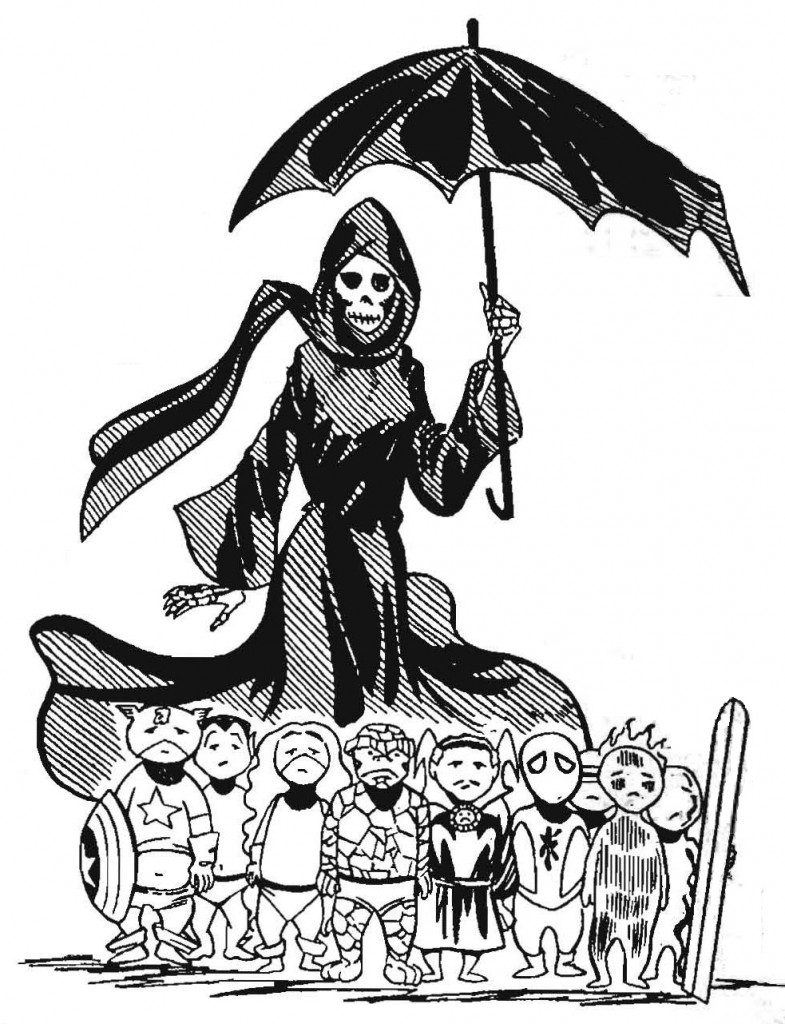
So it is, with profuse apologies to Edward Gorey (and thanks to Richard Howell for the accompanying art), that But I Digress presents:
THE MARVELCRUMB TINIES
by Peter David
A is for Amazing Spider-Man Clones.
B is for Bankrupt (it beats paying loans).
C is for Carl, the Icahn Ron fears.
D is for Debt, with accounts in arrears.
E is for Employees, cut by a third.
F is for F***ed (well, we can’t print that word).
G is for Gruenwald, who’s terribly missed.
H is for Holders of Bonds, who’ve been dissed.
I is for Ideas, the House of, in foreclosure.
J is for Jim Lee with “Reborn” exposure.
K is for Killing direct-market pride
L is for Liefeld, whom fans crucified.
M is for McFarlane, Rob’s former beau.
N is for Net Worth, now sinking way low.
O is for Office with dwindling worth.
P is for Perelman, who’s leaving scorched earth.
Q is for Questionable ways Ron makes loot.
R is for Retailers gone down the chute.
S is for Stocks, with the bottom all gone.
T is for Toy Biz in clutches of Ron.
U is for Usenet, with fans speculating.
V is for “Vulture Investors” left waiting.
W is for Warners, a possible buyer.
X is for X-Men, and, also, X-pire.
Y is for the Year that kept rumors all humming.
Z is for Zero, the Hour that’s coming.


 •
• 
It’s actually amazing to see where Marvel when you think about how some of the fanzines and industry press was seeing their doom. I even remember some people talking about DC/Warner’s grabbing them up.
They’re still not the powerhouse that they once were, but between their acquisition by Disney and the success of their films, Marvel as a brand and their characters aren’t going anywhere for a long, long time.
“. . . their characters aren’t going anywhere for a long, long time.”
Yeah, in more ways than one, not all of them good. The phrase “narrative stasis” comes to mind. Can you say “status quo” kids?
Speaking as someone who spent his entire run on “Friendly Neighborhood Spider-Man” doing nothing but shifting and adjusting his plans to accommodate stories over which he had no control, I feel pretty confident in saying that your definition of “status quo” and “narrative stasis” is not remotely the same as mine.
PAD
Marvel ain’t the only one going with the “status quo.” If one is to go by the “DC One Million” event from a few years ago, thousands of years in the future there won’t be new heroes, just different versions of the current Justice Leaguers.
I’m not sure what having to adjust your plans to accommodate others’ storylines has to do with Jay’s assertion about the characters remaining mostly the same, Peter, but he’s right. The Big Two don’t want any changes to their iconic characters, which means that most of them exhibit little or no substantial difference from how they were when they first appeared decades ago. (Things like costumes, team lineups and relationship status do not count.) While this has certainly never been true for you, since you’ve always shown a willingness to change the status quo and stick with the change in books like Hulk and New Frontier, most other writers, and editorial for that matter, are generally reluctant to this, and tend to substitute developmental cycles, reset buttons and retcons for substantial, long-term and permanent development.
Jean Grey’s alive. Then dead. Then alive again. Then dead again. Then alive. Now Betty Banner is dead. And Nick Fury. And Thor. And now Captain America. Then Reed Richards. Then Johnny Storm. No, wait, they’re alive again. Oh, and Bucky too.
Sean Cassidy and Jessica Drew are de-powered. No, they have their powers back.
The X-Mansion is destroyed. Then rebuilt. Then destroyed again. Then rebuilt.
Storm, Wolverine and Shadowcat have new costumes. No, we’re gonna change them back to how they were when they first appeared.
Hey, wait, Peter and Mary Jane got married. And it seems to be a permanent development that isn’t going to be cha–oh wait, they retconned it.
Fiction is supposed to explore the major passages of life, and how people constantly transition and grow throughout their lives. Marvel and DC, however, largely just go in circles, and in so doing, they betray the role that writers are supposed to fulfill.
The worst example is Professor X. He’s paralyzed. Oh, he’s better. Oops, no, he’s paralyzed again. Yay, he got better again! It’s like a bad Family Guy joke.
“Marvel ain’t the only one going with the “status quo.” If one is to go by the “DC One Million” event from a few years ago, thousands of years in the future there won’t be new heroes, just different versions of the current Justice Leaguers.”
New characters don’t really take off all that well. At least not to the point of getting a sustainable ongoing series. Older readers are often skeptical of trying anything new, and I’ll even admit that of myself. When it comes to super-heroes, it’s probably better off to create them for movies or kids’ TV. I mean, the last big superhero property to take off anywhere was Ben 10 which was created for TV. I think that says something.
Exactly. It’s like it doesn’t occur to anyone that people thousands of years from now will come up with new ideas, new identities, or new anything. It’s as if they’re all going to do nothing more than copy the past. When you consider how ignorant of history the average American tends to be, this is particularly laughable.
Not only do new characters not take off very well, but there are more avenues now for someone with a really good idea for a new character – you don’t sell them to the Big Two, you retain ownership and go elsewhere (e.g. Image) or self-publish. But consider, too, after almost 75 years of superheroes, the basic, iconic character archetypes are pretty well mined. And in the old days, the miners were the likes of Will Eisner, Jack Kirby, Gardner Fox, et al, and even THEY repeated themselves (Eisner: Spirit -> Midnight; Kirby: Cap -> Fighting American, New Gods -> Eternals -> lots of other godly motifs). Not to say that re-exploring old motifs is bad, and not to say that less archetypical characters can’t work…it’s just way harder!
As for an event like DC One Million…did anyone expect them to come up with dozens of new characters for a single event? Really? Even coming up with dozens of new costumes that work is tough (see, for example, the (IMHO) general blahness of the New 52 redesigns). Unless you’re George Perez or Alex Ross, of course, in which case it’s the work of a weekend!